
Drift Protocol Exploit: What Happened and How It Affects Vault Operators
Apr 7 | 3 Minutes MIN | Drift Vaults
By
Kvants Team
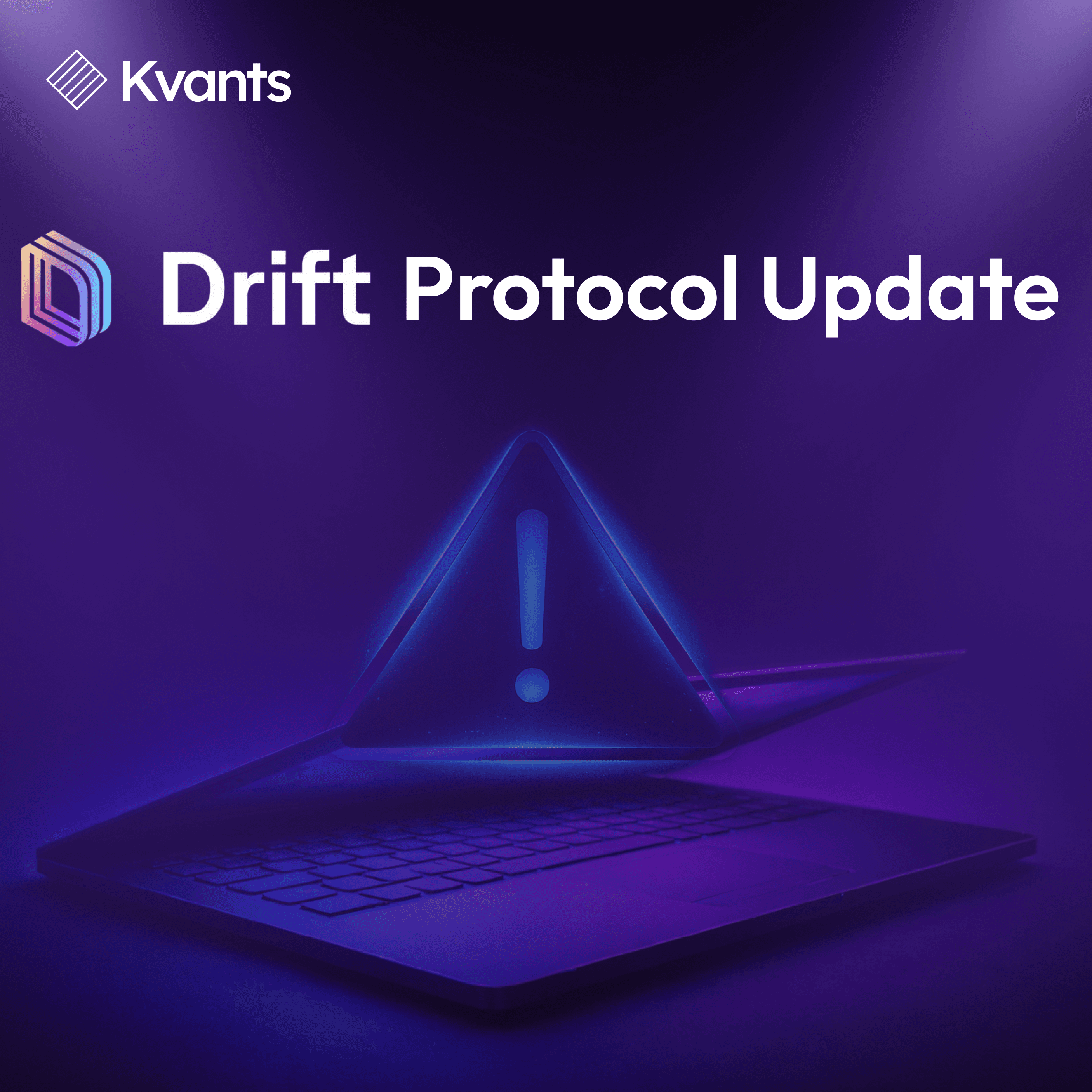


On April 1, 2026, Drift Protocol experienced a significant security exploit resulting in approximately $285 million in losses across the protocol. As a vault operator that deployed strategies on Drift’s infrastructure, we want to provide our community with a comprehensive overview of the incident, its impact across the ecosystem, and how we are moving forward.
The Root Cause
The exploit did not result from a sophisticated external attack on Drift’s codebase. It originated from changes made internally by the Drift team.
In the weeks prior to the incident, Drift reconfigured its multisig to a 2-of-5 structure and did so without implementing a timelock — the industry-standard safeguard that creates a mandatory delay between proposing and executing governance changes. This decision, made solely by Drift’s team, removed the very mechanism designed to prevent unauthorized access. The attacker exploited this opening to manipulate oracles, introduce fabricated collateral, and drain the protocol’s core vaults.
Drift had received passing security audits from Trail of Bits and ClawSecure. Vault operators — including Kvants — reviewed these audits as part of their due diligence before deploying strategies on the protocol. The governance changes that created the vulnerability were made by Drift after those audits were completed, without notification to the ecosystem of operators and protocols building on top of its infrastructure.
No external party had visibility into these internal governance decisions. No external party was consulted. No external party could have prevented what followed.
How This Affected the Broader Ecosystem
Drift was not simply an exchange. It operated as foundational infrastructure for an entire ecosystem of vault operators, yield platforms, and strategy protocols across Solana. Every protocol that integrated with Drift did so based on its public security posture — a posture that, unbeknownst to the ecosystem, had been materially weakened by Drift’s own governance changes.
When the exploit occurred, every protocol with TVL deployed through Drift’s infrastructurewas impacted — PiggyBank, Ranger Finance, Reflect Money, Kvants, and many others. The losses experienced across these platforms trace back to a single point of failure: decisions made within Drift that no downstream operator had the ability to influence, override, or even observe.
Each affected protocol conducted its own due diligence. Each reviewed the available audits. Each assessed Drift as a reliable infrastructure layer based on publicly available information. The risk that materialized was not one that due diligence could have caught — because it was introduced privately, after the fact, by the very team responsible for maintaining the protocol’s security.
Kvants’ Response
Since the moment the exploit was detected, we have been in direct communication with the Drift team, actively monitoring recovery efforts and tracking the movement of stolen funds alongside blockchain security firms.
We made the deliberate decision to wait for the full picture to emerge before issuing a public statement. In a situation where new information was developing by the hour, we believed our community deserved confirmed facts — not rushed speculation that might need to be corrected later.
All Kvants vault operations on Drift were paused immediately. Our infrastructure on other platforms remains unaffected and fully operational.
Kvants vault deposits that were deployed on Drift at the time of the exploit were affected. It is important to understand how Kvants vaults operate. Kvants vaults are fully permissionless — users deposit directly into smart contracts and withdraw directly from smart contracts. At no point does Kvants take custody of, control, or have access to user funds. This has always been the case and remains the case today.
Because user funds were held entirely within Drift’s infrastructure, the recovery effort and the responsibility for making affected users whole sits entirely with Drift. Kvants had no ability to move, withdraw, or safeguard funds that were held within Drift’s protocol — only Drift had that access, and it was Drift’s governance decisions that led to the exploit.
Any questions regarding the recovery of funds, timelines, and compensation should be directed to the Drift team. We will continue to monitor the situation closely, maintain our communication with the Drift team, and share relevant updates with our community as they become available.
What This Means for DeFi Infrastructure
This incident raises important questions that the entire ecosystem must address. When vault operators and protocols build on top of foundational infrastructure, there is an implicit trust that the underlying protocol will maintain its security commitments. When that trust is broken by internal governance changes made without transparency, the consequences cascade far beyond the protocol itself. The responsibility for maintaining that trust — and the accountability when it fails — sits with the protocol that holds the keys. Vault operators can audit code, review security reports, and perform extensive due diligence. What they cannot do is monitor private governance decisions made behind closed doors.
Going forward, the industry needs mandatory timelocks on all governance changes for protocols managing significant TVL, transparent notification to downstream operators when security parameters are modified, real-time governance monitoring tools that give the ecosystem visibility into infrastructure changes, and broader adoption of DeFi insurance to protect users from risks that no amount of due diligence can eliminate.
We remain fully committed to transparency throughout this process and will continue sharing updates as the situation develops.
Information current as of April 6, 2026. The situation remains developing.

Read more