
From Trading Idea to Backtested Strategy: How Kvants Studio Works
Mar 10 | 7 Mins MIN | Kvants Studio
By
Kvants Team


From Trading Idea to Backtested Strategy: How Kvants Studio Works
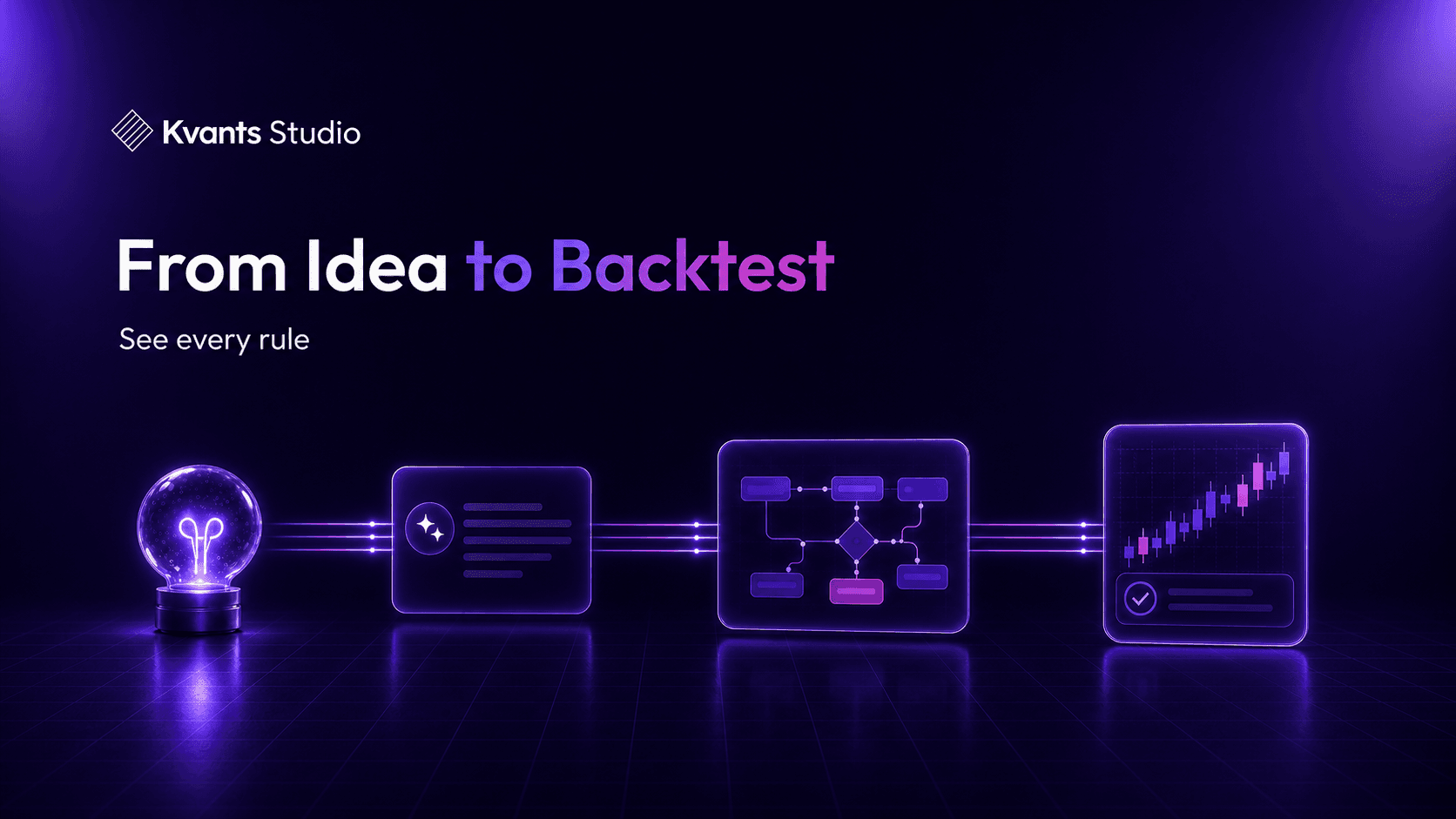
A trading idea often starts as a sentence: “Buy strong breakouts, avoid high volatility, and exit when momentum fades.” The difficult part is turning that sentence into precise, testable rules.
Kvants Studio compresses that workflow into a visual AI workspace. You write the idea in plain English, inspect the generated strategy graph, run a backtest, refine the assumptions, and decide whether the strategy is ready for paper trading or export. No coding is required to get started.
Step 1: Describe the idea
Use ordinary language, but be specific about the parts that matter. Name the market and timeframe. Explain the entry condition, exit logic, position sizing, and risk limits.
For example:
“Build a daily long-only strategy for liquid US stocks. Enter when price breaks above the prior 50-day high while volume is above its 20-day average. Exit on a close below the 20-day moving average. Risk 0.5% of equity per position and cap total exposure at 50%.”
The prompt is a starting specification, not a magical instruction. If something is ambiguous, you should resolve it before treating the result as a strategy.
Step 2: Let AI draft the structure
Kvants Studio converts the description into a connected graph. Nodes represent the data source, indicators, conditions, entries, exits, sizing, and risk controls.
This structured output is important. Instead of receiving opaque code or a one-off answer, you get a model you can read. You can see which rule triggers an entry, how the exit is evaluated, and where the risk limit enters the workflow.
Step 3: Inspect and edit every rule
Review the graph before running a test. Confirm the market, symbol universe, date range, timeframe, indicator periods, and execution timing. Look for assumptions that could create look-ahead bias or an impossible fill.
If a change is needed, describe it in plain English—“execute on the next bar,” “add a volatility filter,” or “reduce the position size”—or edit the graph directly. The point is to keep AI assistance transparent and under your control.
Step 4: Run a realistic backtest
A backtest estimates how the rules would have behaved on historical data. Its value depends on the quality of the assumptions.
Account for fees and slippage. Use funding assumptions for derivatives where relevant. Include sufficient data for indicator warm-up. Make sure signals use only information available at the decision time.
Then inspect the trade list, drawdowns, turnover, exposure, and risk-adjusted metrics. Do not rely on a single performance number. A strategy that looks attractive overall may depend on one period, one asset, or a handful of trades.
Step 5: Validate across different conditions
Robustness testing asks whether the idea still makes sense when the environment or assumptions change. Preserve an out-of-sample period. Test different market regimes. Apply small parameter variations and less favorable cost assumptions.
Kvants Studio makes it easier to create controlled variants in plain English while keeping the changes visible. That speed should support disciplined research, not endless optimization of historical results.
Step 6: Paper trade before real capital
Paper trading adds a live operational test without committing capital. It can reveal timing mismatches, data gaps, order-frequency issues, and behavior that a historical simulation did not capture.
Treat paper trading as another source of evidence. It is not a guarantee that a strategy will perform similarly with real orders and real market impact.
Step 7: Export or continue in the workspace
Where supported, you can export strategy artifacts such as Pine Script or a Kvants strategy file. You can continue to review the logic, share it with a collaborator, or use it in another part of your research workflow.
The strategy remains something you can inspect and modify. Kvants Studio is built to shorten the distance from a human idea to transparent, testable rules.
What changed from the earlier Kvants narrative
Kvants Studio is not a digital-asset vault, managed fund, or asset-management product. It does not pool user capital or promise automated returns. It is an AI trading strategy builder for stocks and crypto.
The core experience is simple: describe a strategy in plain English, review the AI-generated graph, backtest the logic, refine it, and stay in control of the decision.
Try a focused first strategy
Begin with one market, one timeframe, and explicit risk limits. Write the thesis in plain English and use Kvants Studio to turn it into a graph you can challenge. The best outcome is not a perfect backtest; it is a strategy whose logic and limitations you understand.
Backtests and simulations are hypothetical and do not guarantee future results. Kvants Studio provides strategy-building and research tools, not personalized investment advice.

Read more